
.
A week or so after I was set up, I was casually eating dinner one evening when I happened to look out the side window.

Much to my surprise, a female black bear, with three cubs in tow, had just walked through the RV pads! I took these shots through the window since I certainly wasn't going to go outside for a closer shot.

As soon as mama bear decided it was time to leave, I hopped outside and reattached the electric fence. Wild Bill, the other volunteer, and I had become a little too complacent about keeping the fence closed during the day. I can assure you that we never neglected to close it again. ;) This mother bear's territory was right around the living quarters, and we sure didn't want her and her youngsters to get used to visiting too close.
.
On July, 23, 2007, I got up very early so I could drive the 20 miles to meet the US Coastguard at the Pamlico Sound. They would be taking a group of volunteers from Pea Island and Alligator River out to a man-made island in the sound.
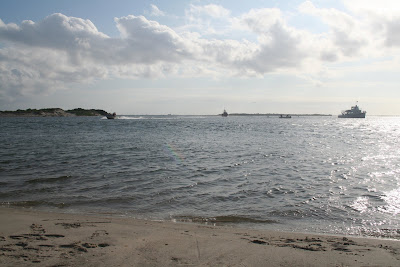
They dropped us off on the island and would return later in the day to pick us up. Our mission for the day was to round up all the baby pelicans for banding.

The young pelicans ranged in age from newly hatched....

to about six weeks old. I wouldn't exactly call them cute....more like something only a mother could love!
.
After chasing, and catching the older juveniles, we took them one by one to the banders.
 There is a method to handling these birds. You have to grab their beak with one hand, so you don't get pinched. Then grab both wings by the shoulder area with the other hand. Their webbed feet have very sharp nails on them, so I chose to hold them away from my body. Doing that also meant that I avoided being barfed or pooped on. :) Did you know that a pelicans pouch feels like the softest kid glove leather?

After the banding, you had to return them to where you found them (in the same nursery group). What a day it was! We scoured the whole island and found and banded over 500 youngsters that day. We worked as quickly as we could since all of the adults were air born and circling overhead.
.
The Coast Guard did return for us as promised, and we even saved some boaters in distress on our way back to the mainland. Their engine had died, and they were just floating along. We towed them back to port. A wonderfully exciting day, all in all.
.
My duties at Alligator River were quite different from those at Pea Island. I still worked at the visitor's center every Tuesday, but once or twice a week, I took people on five mile canoe trips through two lakes and several long, swampy, Cypress channels.
 This is the spot where we put in for the canoe trips. We went under the bridge and then headed left on the lake to the channels through the swamp. I presented an interpretive program on the history of the swamp as we paddled. I seldom had a passenger in my canoe, so that made the curvy channels a real challenge. I ended up putting a couple of cement blocks in the bow of my canoe to keep the front end down. The average temperature in the swamp was 100*, and I was always dripping wet when we returned (and certainly not from falling in). There are a lot of stories to tell about these canoe trips, but it would take way too long here. Ask me sometime when you see me.
.
On a few Wednesday nights, I led a bear finding tour of the refuge. It began by my presenting a short talk on the black bear and the endangered red wolves that are found on the refuge. I would then lead an auto caravan on the back roads of the refuge hoping to see some bears. I gave each car a walkie-talkie so I could communicate with everyone as we drove along. That was always a popular tour with visitors.
.
When I wasn't busy with the tours or at the visitor's center, I maintained the Charles Karault Trail in the refuge. I also painted road signs and did a lot of litter pick up along the roads. It was a busy and exciting three months that I spend working on both these refuges, and except for the chiggers, I enjoyed it all!

Sunset on Alligator River National Wildlife Refuge.
.
Thanks for stopping by....talk to you later, Judy

P.S. I almost forgot....Alligator River is where I saw my first Luna moth...it was about 6" across.


 In June of 2007, I began my volunteer assignment at Pea Island National Wildlife Refuge. Pea Island is located in the middle of the Cape Hatteras National Seashore on the coast of North Carolina.
 The front yard of my volunteer site was the Atlantic Ocean. I only had to walk about twenty paces to have this view. I spent many on evening walking up and down this pristine beach looking for shells. I have always wanted to live by the ocean, and for a month my dream came true.
 I was able to visit all three of the lighthouses on the national seashore.
 Bodie Island (pronounced body)...
 Cape Hatteras lighthouse...
 and the Ocracoke Island lighthouse. Each is painted differently to aid in mariner's navigation. Their beacons at night are also different so sailors knew their location along the coast.


 Posts


