.

.
Borrego Springs, CA
Showing posts with label Pea Island National Wildlife Refuge. Show all posts

Sunday, January 9, 2011

Sea shells on the sea shore

One of the many blogs that I read is written by ANN.  I met John and Ann this summer while I was staying at Red Rock RV Park in Idaho.  They are spending the winter near Rockport, TX, and recently found a beach down there with a mother lode of sea shells.  When I read her post this afternoon, it brought back memories of the last time I had the joy of walking an ocean beach looking for shells.

IMG_0504It was back in the summer of 2007, and I was volunteering at Pea Island NWR and Alligator River NWR.

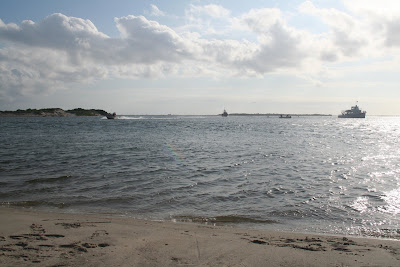
IMG_0423What a summer that was!  This was the view of the Atlantic right out my front window.  Pea Island is located on the Outer Banks of North Carolina.  I spent a little over a month living on the shore.

IMG_0501 IMG_0502 This was a display in the Visitor’s Center, but it truly depicts the sea turtle nest hatchlings ‘boiling’ to the surface of the beach.

IMG_0513Volunteers would monitor each nest and construct a runway for the hatchlings to reach the ocean.  We would arrive at the nest at 7:00 at night and stay until midnight.  These sea turtles always hatch at night and need to be protected from the ghost crabs that will kill them all before they reach the water.  If you’re lucky enough to be there on a night that the eggs hatch, you have to literally beat the crabs off with a stick!  One of the nights that I was on watch, an entire nest hatched.  It was an exhilarating experience to insure that all little turtles made it to the sea.

IMG_0485 IMG_0488

On a different day, I helped band 500 young brown pelicans on an island off the coast.  The young pelicans were not real happy about this, and showed their disdain by emitting foul substances from both ends!  Those big pouches that they have feel like the softest kid glove leather.

IMG_0495After a month or so, I moved over to sister refuge, Alligator River, and had other creatures to contend with.  This mother black bear with three cubs came into the RV pads when we neglected to make sure the electric fence was turned on one day at lunch time.  We never forgot again.  :)


I know some of you may remember some of these pics from when I did my Sunday Blast from the Past posts about a year and a half ago, but then again maybe you don’t.  :)  Anyway,  ANN talking about collecting shells took me mentally back to that time on Pea Island.


It was cold and rainy and windy when I drove in to open the VIS this morning.  Absolutely no one was visiting, and who could blame them?  The wind out of the east kept getting stronger and stronger, and I began to worry about my slide toppers back at the rig.  Then the electricity went out!  I was plunged into darkness, and no way to heat the VIS shed.  I waited almost an hour, and then decided to close up and head for home. 


For a minute, I didn’t think I was going to be able to get all the way into the rig.  Once I pried the door open, it flew open and I was stuck in the doorway trying to hang onto the door, and get it closed with my computer backpack wedged against the side of the door frame.  Time seemed to stand still as I struggled to get the door shut against the wind, and Emma kept trying to lick my face!  Ugh! 


I did finally get it closed, and then I tried to get the slide outs in.  The bedroom slide came in easily, but the big living room slide would only come partially in.  I tried three times.  Ugh, again!  Okay, so I took a big breathe and waited for what I thought was a slight lull in wind.  The fourth try worked, thank goodness.  It’s not unusual for it to be windy in Texas, but today was ridiculous!! 


Thanks for stopping by…. talk to you later,  Judy

Sunday, September 20, 2009

The Sunday Blast from the Past

After a month on the ocean at Pea Island NWR, I moved over to the main land at Alligator River NWR. The two refuges share a visitor's center and staff work at both locations. I moved because I had absolutely no cell phone reception or internet out on the island. I was also growing tired of having to completely wash the salt spray off of the rig each week.
.
A week or so after I was set up, I was casually eating dinner one evening when I happened to look out the side window.
Much to my surprise, a female black bear, with three cubs in tow, had just walked through the RV pads! I took these shots through the window since I certainly wasn't going to go outside for a closer shot.
As soon as mama bear decided it was time to leave, I hopped outside and reattached the electric fence. Wild Bill, the other volunteer, and I had become a little too complacent about keeping the fence closed during the day. I can assure you that we never neglected to close it again. ;) This mother bear's territory was right around the living quarters, and we sure didn't want her and her youngsters to get used to visiting too close.
.
On July, 23, 2007, I got up very early so I could drive the 20 miles to meet the US Coastguard at the Pamlico Sound. They would be taking a group of volunteers from Pea Island and Alligator River out to a man-made island in the sound.

They dropped us off on the island and would return later in the day to pick us up. Our mission for the day was to round up all the baby pelicans for banding.
The young pelicans ranged in age from newly hatched....
to about six weeks old. I wouldn't exactly call them cute....more like something only a mother could love!
.
After chasing, and catching the older juveniles, we took them one by one to the banders.
There is a method to handling these birds. You have to grab their beak with one hand, so you don't get pinched. Then grab both wings by the shoulder area with the other hand. Their webbed feet have very sharp nails on them, so I chose to hold them away from my body. Doing that also meant that I avoided being barfed or pooped on. :) Did you know that a pelicans pouch feels like the softest kid glove leather?
After the banding, you had to return them to where you found them (in the same nursery group). What a day it was! We scoured the whole island and found and banded over 500 youngsters that day. We worked as quickly as we could since all of the adults were air born and circling overhead.
.
The Coast Guard did return for us as promised, and we even saved some boaters in distress on our way back to the mainland. Their engine had died, and they were just floating along. We towed them back to port. A wonderfully exciting day, all in all.
.
My duties at Alligator River were quite different from those at Pea Island. I still worked at the visitor's center every Tuesday, but once or twice a week, I took people on five mile canoe trips through two lakes and several long, swampy, Cypress channels.
This is the spot where we put in for the canoe trips. We went under the bridge and then headed left on the lake to the channels through the swamp. I presented an interpretive program on the history of the swamp as we paddled. I seldom had a passenger in my canoe, so that made the curvy channels a real challenge. I ended up putting a couple of cement blocks in the bow of my canoe to keep the front end down. The average temperature in the swamp was 100*, and I was always dripping wet when we returned (and certainly not from falling in). There are a lot of stories to tell about these canoe trips, but it would take way too long here. Ask me sometime when you see me.
.
On a few Wednesday nights, I led a bear finding tour of the refuge. It began by my presenting a short talk on the black bear and the endangered red wolves that are found on the refuge. I would then lead an auto caravan on the back roads of the refuge hoping to see some bears. I gave each car a walkie-talkie so I could communicate with everyone as we drove along. That was always a popular tour with visitors.
.
When I wasn't busy with the tours or at the visitor's center, I maintained the Charles Karault Trail in the refuge. I also painted road signs and did a lot of litter pick up along the roads. It was a busy and exciting three months that I spend working on both these refuges, and except for the chiggers, I enjoyed it all!
Sunset on Alligator River National Wildlife Refuge.
.
Thanks for stopping by....talk to you later, Judy
P.S. I almost forgot....Alligator River is where I saw my first Luna moth...it was about 6" across.


Sunday, September 13, 2009

The Sunday Blast from the Past

In June of 2007, I began my volunteer assignment at Pea Island National Wildlife Refuge. Pea Island is located in the middle of the Cape Hatteras National Seashore on the coast of North Carolina.

The front yard of my volunteer site was the Atlantic Ocean. I only had to walk about twenty paces to have this view. I spent many on evening walking up and down this pristine beach looking for shells. I have always wanted to live by the ocean, and for a month my dream came true.

I was able to visit all three of the lighthouses on the national seashore.

Bodie Island (pronounced body)...

Cape Hatteras lighthouse...

and the Ocracoke Island lighthouse. Each is painted differently to aid in mariner's navigation. Their beacons at night are also different so sailors knew their location along the coast.
.
I really enjoyed the names of places here, like Nags Head, Kitty Hawk, and Ocracoke Island. I ate my first crab cake on Ocracoke Island and liked it.
.
The visitor's center, where I worked was the busiest that I've worked in. It was not unusual to have over 200 visitors a day and do $800 worth of sales. Besides answering questions, selling items, and restocking, the visitor's center handles all the reservations for the canoe and bear watching tours for Pea Island and it's sister refuge, Alligator River NWR. Normally, volunteers come in pairs and both husband and wife man the center. Since I travel solo, I had to do it alone. The days I worked in the visitor's center, the time flew by because of being so busy. If there was ever a lull in the crowd, I had to lock up and dash across the parking lot to the bathroom. There were always folks waiting for me to return. ;)
.
One of the enjoyable things I got to do was be a participant in the turtle watch. Each summer sea turtles arrive at night to dig a nest hole and deposit their eggs. These nests are monitored by volunteers and after close to two months, nightly turtle watches begin.
The circle at the top of the picture is the location of the nest. We use garden edging to construct a runway for the young turtles to travel down to the ocean. You're probably wondering why. Well there are two reasons. One is that these turtles are endangered and the path gives them a straight shot to the ocean. The other reason is the most important one. The runway combined with volunteers with sticks patrolling it keep the ghost crabs away from the hatchlings. If we didn't flip the crabs away, they would kill all the young. They run up and snip the muscles of a flipper and then move on to find another victim. Eventually, they come back and drag the incapacitated turtles down their crab holes. If we didn't guard these nests, there would be very few turtles that would make it to the sea. Now if I could just remember the name of this species of turtle I'd be happy, but my mind is drawing a blank right now...sorry.
The eggs are buried deep in the sand and are the size of a golf ball. This photo, and the next, are from the display at the visitor's center. It will give you a good idea of what I'm talking about.

The turtles always hatch at night and use the light of the moon to direct their way to the ocean. There can be close to one hundred eggs in a nest and most hatch at the same time. When they begin to climb to the surface it is called a boil, and that is exactly what it looks like....water boiling. I was lucky enough to be on hand when a nest hatched. The nests are "watched" from 7:00 pm until midnight. My first night on patrol, we had a boil at about 9:45. It was my job to count the number of hatchlings as they began their way down the path. We had 49 hatch that night, and all made it to the ocean thanks to the diligent stick patrol! You might think it would be easier if we just picked them up and carried them to the water, but that won't work. Each hatchling must make that perilous journey on it's own so that the location of the beach will forever be imprinted on them. That way, they will know where to come back to breed when they are old enough.

.

I have many more memories of my time at Pea Island. It was a dream come true to live by the ocean (although having to completely wash the rig each week because of the salt spray was a challenge!)

.

Thanks for stopping by....talk to you later, Judy