

A couple of commenters wanted to know why I was sorting through salmon eggs one at a time. What was I looking for? I appreciate those questions. It gave me the topic for tonight’s blog post. :) Bandon State Fish Hatchery, in Oregon, is a very precise operation when it comes to salmon eggs! They provide viable eggs for hatcheries throughout the state.
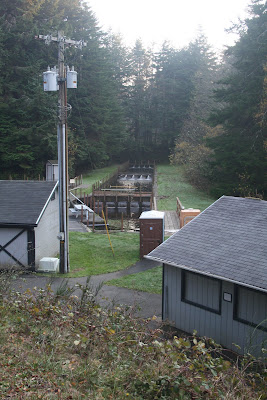
 And this is the building where all the action happens. It is located along a river that empties directly into the Pacific Ocean, and the salmon make their way up stream to spawn. The hatchery catches them on a fish ladder, harvests the eggs and milt, and mixes them together in this building.
 These are the incubators. There is a constant flow of river water through these incubators. I think the temperature of the water is a constant 45*, but sometimes I forget those little details. Suffice it to say, that the inside of the building isn’t what you would call warm. :)
 Each of these trays in the incubator contain hundreds of eggs. Notice that they are not all a healthy pink color.
 After being in the incubator for a certain amount of days, each tray is taken out and poured into this machine. Take note of the screen on the right, that’s where we do the sorting.
 As the eggs go through this machine, a laser light kicks out the obviously cream colored rotten eggs, and shoots out the rest into this holding tank. My job was to scoop out a bunch of eggs with a strainer, and then go through each one individually looking for the beginnings of that opaque cloudiness. The other thing that we had to do was check how many eyes each egg had. Yes, that’s right! A good egg has two eyes (black dots), but some eggs would have three or more, and that means they weren’t viable. The less than perfect eggs were put into a separate strainer for disposal. Since I was the only volunteer that December, I was often the only one sorting eggs.
Lest you think this was a totally boring procedure, picture this: Occasionally, I would dip out too large a scoop of eggs, and as I poured them onto the screen they would overflow and some would drop to the floor. I’m sure you’ve seen those super bouncy balls? Well, salmon eggs do the same thing! I’d be running around trying to catch those bouncing eggs, and giggling all the way. Can’t waste those eggs, you know, and then someone would shout down from the offices above and ask “Is everything all right?” And I’d respond, “ Oh, yes, everything’s under control!” :)
 Here’s a tray of sorted eggs. See that measuring cup on the left? After all the eggs were sorted, then we had to count them! One of the staff would come down, and we’d both count a cup of eggs at a time. We did this three times in a row to determine the average count. That guy could sure count fast! Then the good eggs were measured out back into the trays and put back in the incubators. I believe I sorted and counted over a half million eggs while I was there. What an unusual thing to have on one’s resume. :)
It was a real hoot to be there for a month, and I really learned a lot about salmon fish culture. I think I’d do it again, but only for a month. :)
Thanks for stopping by….talk to you later, Judy


 My duties at Bandon were varied. See all those nets?


 Posts
Posts


